
Oktibbeha Release Date Meanings
A projected date is a forecast. An actual release date is a recorded event. Mississippi Department of Corrections uses the exact public label “Tentative Release Date” on its inmate detail pages. MDOC also calculates an ERS date and a maximum release date. A parole eligibility or hearing date belongs to a different Board process. Those labels should not be merged into one promised day.
For a person held before trial at Oktibbeha County Jail, no fixed date may exist. Bond can be posted, a judge can act, charges can change, or another custodian can take over. A sentenced county inmate may have an expected endpoint based on the judgment and credited time, but the Sheriff publishes no local good-time formula or weekend-release policy. The jail’s actual release record and the court order control.
- ERS date
- The earliest date MDOC calculates for possible Earned Release Supervision.
- Tentative Release Date
- MDOC’s present anticipated endpoint after its sentence and time calculations.
- Maximum release date
- The sentence endpoint without the same tentative assumptions, subject to lawful credits and orders.
- Actual release date
- The historical exit event shown in the custodian’s official record.
Find Oktibbeha Inmate Release Dates
Begin by deciding whether the person has an MDOC sentence or an Oktibbeha County Jail case. MDOC’s public Inmate Search accepts first name, last name, or MDOC ID. Its result template can show entry date, location, unit, location-change date, sentence data, county of conviction, sentence date, and Tentative Release Date. An Oktibbeha conviction field identifies the county tied to that sentence; it does not prove release from the present county jail.
A jail detainee may not appear in MDOC at all. For local custody, call the Sheriff with the name, date of birth or booking ID, and case date. Ask for the actual release date and time, release type, authorizing court, and transfer destination if one exists. Then read the proper Municipal, Justice, or Circuit Court record to understand the legal event.
- Classify the case as county jail, MDOC state prison, federal sentence, or another custodian.
- For MDOC, search by MDOC ID or name and compare the full set of identifiers.
- Read the field exactly as “Tentative Release Date” and record the search date.
- For county custody, ask the jail for its existing release record and the court for the controlling order.
- If parole or ERS is possible, check community-supervision records instead of assuming full discharge.
- Confirm the completed event with a discharge certificate or the sending custodian’s release record.
The MDOC Inmate Search form shows the name and ID inputs used for state sentence records.

This state form is useful only when MDOC has the person’s sentence or custody record. It is not an index of every Oktibbeha County Jail booking.
Oktibbeha State Release Dates
Mississippi’s three main state-sentence concepts serve different purposes. ERS is a possible supervised release point. Tentative Release Date is the exact result-page field for the system’s current anticipated date. The maximum date reflects the term endpoint under a different set of assumptions. Parole eligibility is separate and comes from Miss. Code § 47-7-3 and the Mississippi State Parole Board process. MDOC states that ERS eligibility is not automatic release. Conduct, classification, an approved in-state residence, sentence structure, and corrections to jail credit can affect what happens. A person released on ERS is physically outside prison but remains an inmate under MDOC jurisdiction until the term ends. Parole is also supervised release, but it rests on a Board decision. Full discharge is a later status.
The MDOC supervision-types page supplies these distinctions.

The state definitions show why a tentative screen result cannot stand in for proof that a person left custody or completed the sentence.
Note: A parole eligibility date, ERS date, tentative date, and actual discharge date answer four different questions.
Oktibbeha Earned Release Dates
Mississippi earned-time law is often shortened to an “eighty-five percent” rule. That shorthand is not a safe personal calculator. For many eligible offenses committed after June 1995, Miss. Code § 47-5-138 provides an earned allowance of up to 4.5 days for each thirty days served, capped at fifteen percent. The corresponding MDOC explanation describes eighty-five percent in the facility and the remaining portion on ERS for eligible cases.
Eligibility exclusions, offense date, later amendments, sentence structure, conduct, classification, and special provisions all matter. The MDOC-hosted statutory PDF may lag later amendments, including changes noted in the research. A current legal text and MDOC sentence record are safer than applying a flat percentage. Administrative earned time also does not reduce the separate parole-eligibility minimum set by § 47-7-3.
MDOC calculates the term, ERS, tentative, discharge, maximum, and parole-related dates from its records. Eligible presentence jail time can shift the sentence start when it relates to the cause, falls within the proper period, and is not duplicated. Court-ordered credit is still posted subject to those limits. For questions about offender time, jail credit, or eligibility, MDOC lists its Records Department at 601-933-2889 and MDOCRecordsDepartment@mdoc.state.ms.us.
Why Oktibbeha Release Dates Change
A release estimate can move because the inputs move. Some changes arise from conduct or classification within MDOC. Others come from a court, a correction to presentence credit, a new sentence, or a hold from another authority. A detainer is a request or notice that another agency may assume custody. It can turn an exit from one system into a transfer rather than return to the community.
| Factor | Possible effect | Verification source |
|---|---|---|
| Jail-credit correction | Changes the computed sentence start or time balance | MDOC Records and sentencing court |
| Earned-time eligibility or loss | Moves an ERS or tentative calculation | MDOC time sheet and applicable law |
| Multiple or consecutive sentences | Changes the combined term calculation | Judgments and MDOC sentence record |
| Revocation or amended order | Adds or changes custody consequences | Court or Parole Board record |
| Detainer or transfer | Ends one custody while another begins | Sending and receiving agencies |
| Residence approval or classification | Can delay ERS release despite eligibility | MDOC case and release process |
MDOC also describes Meritorious Earned Time and qualifying work or program milestones with distinct rules and disqualifiers. Those provisions should be read from the current record. They do not support a public do-it-yourself date forecast for a named person.
A changed display should be traced to its source. Compare the current MDOC time computation with the signed judgment and any amended order. When Oktibbeha County jail credit is missing or disputed, MDOC says the person should alert the case manager, while the Records Department handles public questions about offender time and eligibility. The county of conviction supplies relevant credit information, but MDOC applies that information within its own sentence rules.
Parole can also change the expected path without turning the Tentative Release Date into a Board date. A grant allows conditional release under the Board’s authority after all required processing. A denial leaves the state sentence calculation in place, subject to later lawful changes. A revocation can return a person to custody. Each event needs the Board or court record that created it.
Read Oktibbeha Date Results
An MDOC details page can carry a photo, physical descriptors, location fields, sentence count, total length, offense and sentence data, county of conviction, and the Tentative Release Date. Match several identifiers before accepting the record. A photo can help distinguish similar names, but it does not convert the result into an Oktibbeha jail record.
The manifest image below is an active-record example used to show the result layout. It is not a released-person example, and the person’s details are not evidence about an Oktibbeha County release. Its value is the state’s exact field label and the placement of that label among sentence data.
The MDOC example result displays “Tentative Release Date” rather than “guaranteed release date.”
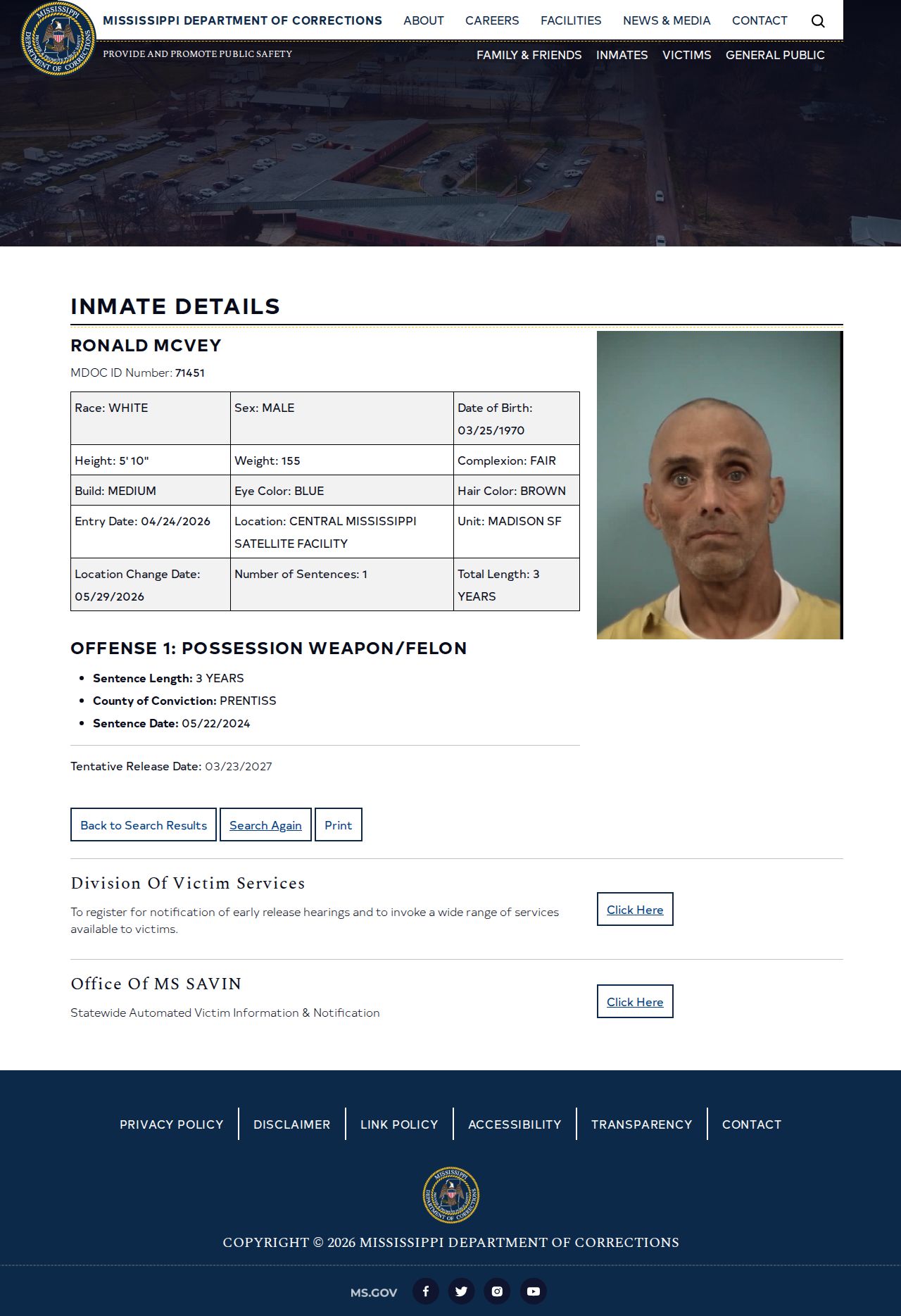
Use that date for planning, then confirm a later departure through MDOC Records, a parolee result, or a discharge certificate.
Oktibbeha Jail Release Dates
The MDOC earned-time framework does not automatically calculate a misdemeanor term at Oktibbeha County Jail. No local good-time formula, public release-processing schedule, or weekend-release policy was found in the Sheriff sources. Do not apply the state eighty-five-percent shorthand to a county sentence. Instead, use the signed judgment, credited-time language, later court orders, and the Sheriff’s actual release record. Justice Court handles misdemeanors and certain early felony matters. Circuit Court is the enduring record source for felony judgments, sentences, and revocations. A Starkville municipal matter may require the Municipal Court record because city prisoners can be housed in the county jail.
The Oktibbeha County Circuit Court page identifies the clerk path for felony records. Justice Court records should be used for matters within that court’s jurisdiction. For the operational date and time a person left the building, contact the Oktibbeha County Sheriff’s Office. A court order may explain the authority for release without showing the exact hour staff processed the exit.
A name disappearing from the current Oktibbeha Sheriff feed proves only that the listing changed. The person may have bonded out, completed local time, transferred to MDOC, moved to another county, or entered another custodian’s control. The Oktibbeha County release-record workflow covers the jail and court proof needed for that historical event.
Mixed custody adds another local check. County records document Starkville prisoners housed at the jail and a limited MDOC trustee arrangement. A removal can therefore reflect a change in custodian. Search MDOC when a state transfer is plausible, and use the correct municipal or county court for the underlying case. The Sheriff release record should identify the receiving authority when that field exists and is public.
Confirm Oktibbeha Actual Release
MDOC says release processing may take thirty to forty-five days and tentative parole or ERS dates are not guaranteed. It also requires a discharge certificate before release. Those statements make final verification a records task, not a date-screen task. Contact MDOC Records about sentence time and eligibility, then request the discharge certificate or final release record for proof.
For county custody, ask the Oktibbeha County Sheriff’s Office for release date and time, release type, authority, and destination if recorded. Join that response to the proper court order. VINELink may supply a person-specific custody-change alert, but the alert may not state whether the event was bond, time served, dismissal, or transfer. The VINELink Release Check can help monitor the pending event while official records establish what occurred.
Note: Keep the search date with every tentative result because sentence calculations and custody facts can change.